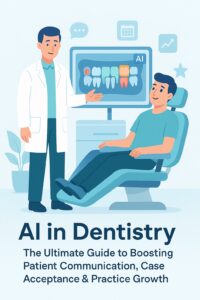
 Artificial intelligence isn’t just a trending buzzword—it’s reshaping the foundations of how dental practices operate, communicate, diagnose, and grow. Over the past two years, AI adoption in dentistry has accelerated at record pace, not only in clinical areas like radiographic interpretation but also in patient communication, marketing automation, and business decision-making.
For dental practices navigating rising competition, staffing shortages, and higher patient expectations, AI has quickly become one of the most powerful tools available. When used strategically, AI enables dentists to work smarter, not harder, reducing administrative burdens while increasing case acceptance, new patient flow, and practice efficiency.
This article breaks down how AI is changing dentistry today—and how forward-thinking practices are using it to elevate patient care, reduce workload, and grow faster than ever.
1. Why AI Is Becoming Essential in Modern Dentistry
Patients today expect instant answers, personalized experiences, and seamless communication. At the same time, dental teams face mounting operational pressure—from full schedules and follow-ups to no-shows and treatment tracking.
AI bridges this gap by automating routine tasks, analyzing patient data, and enhancing the accuracy of diagnostic and administrative processes. What used to take hours now takes seconds.
Key reasons AI is becoming essential:
-
Patient expectations for digital experiences are higher than ever.
-
Labor shortages and administrative overload are increasing stress on dental teams.
-
Cosmetic and elective dentistry demand more personalized consultations.
-
Competition is rising—especially in markets saturated with DSOs.
AI helps practices remain efficient, profitable, and patient-focused—even with limited staff or growing competition.
2. AI for Radiology, Diagnostics, and Treatment Planning
One of the most significant advancements in dentistry is AI-powered radiographic interpretation. AI software can now analyze X-rays, CBCT scans, and intraoral images in real time with remarkable accuracy.
Benefits of AI diagnostics:
-
Identifies decay, bone loss, infections, lesions, and abnormalities with high precision
-
Creates standardized, objective radiographic assessments
-
Helps dentists catch issues earlier
-
Improves patient understanding with visual overlays
-
Supports case acceptance by validating recommendations
When a patient sees a computer-generated visual confirming decay or bone loss, they trust the diagnosis more. AI doesn’t replace the dentist—it reinforces clinical expertise and eliminates subjective interpretation.
Impact on case acceptance:
Practices using AI-enhanced imaging have reported 10–25% increases in acceptance for restorative and periodontal treatments.
3. AI-Driven Patient Communication: The Key to Stronger Relationships
AI is revolutionizing how practices communicate with patients across every step of the patient journey—from the moment they visit your website to post-treatment follow-ups.
AI Chatbots & Virtual Assistants
AI chat tools on dental websites can answer questions instantly, book appointments, share pricing information, or route inquiries to the front desk.
Common chatbot tasks include:
-
Insurance and coverage questions
-
Appointment scheduling
-
Emergency triage
-
Cosmetic consult pre-qualification
-
Post-operative instructions
Today’s dental consumers want fast answers. AI ensures no lead goes unanswered—even after hours.
AI for Phone and Text Communication
AI-powered text messaging platforms can automate:
-
Appointment confirmation
-
Recare reminders
-
No-show follow-ups
-
Reviews and reputation management
-
Treatment plan reminders
A practice that texts instead of calls will see significantly higher response rates—especially among younger patients.
4. AI in Dental Marketing: Getting More New Patients With Less Work
Marketing is one of the most time-consuming and misunderstood responsibilities for dentists. AI dramatically simplifies this by automating content creation, ad optimization, SEO tasks, and follow-ups.
AI Tools Are Now Common for:
-
Creating social media posts and video scripts
-
Writing blogs designed to rank in search engines
-
Optimizing Google Ads in real time
-
Improving website conversions through testing and personalization
-
Managing online reviews and responses
-
Tracking patient behavior to predict treatment needs
AI allows practices to stay visible, relevant, and consistent—without the dentist having to become a marketer.
The New Standard: AI-Powered Patient Acquisition Systems
Companies like Dentist Marketing Media (your brand) now build automated marketing systems powered by AI:
-
AI chat assistants
-
Real-time patient qualification
-
Automated follow-up flows
-
Smart scheduling
-
Lead scoring
-
Predictive analytics
This lets dental practices grow patient volume while reducing the demand on their internal team.
5. AI for Personalized Treatment Plans & Case Acceptance
One of the biggest barriers in dentistry isn’t diagnosis—it’s communication. Patients often struggle to fully understand treatment recommendations, which leads to hesitation or deferrals.
AI solves this with powerful patient-friendly tools:
AI can personalize:
-
Visual treatment simulations
-
Custom diagnostic explanations
-
Payment breakdowns
-
Risk assessments
-
Long-term oral health projections
Patients gain clarity and confidence, which leads to faster and higher acceptance rates.
Example:
AI can show a patient what their smile may look like after whitening, orthodontics, or veneers. Seeing the result—instantly—creates emotional motivation that no brochure or explanation can match.
6. AI for Office Efficiency and Staff Productivity
Administrative workload is one of the top frustrations for dental teams. AI alleviates this by automating tasks that traditionally consume hours of staff time.
AI can automate or streamline:
-
Insurance verification
-
Billing and claims processing
-
Charting
-
Clinical note writing
-
Follow-ups and reminders
-
Inventory management
-
Scheduling optimization
-
Reporting and analytics
When combined, these improvements can save a practice 20–30 hours per week of manpower.
Result:
Staff feel less overwhelmed, schedules run smoother, and patients experience fewer delays.
7. The Role of AI in Reputation Management and Online Reviews
Reviews are one of the most important SEO and patient acquisition factors in dentistry. AI helps practices generate more positive reviews and handle negative ones more professionally.
AI tools can:
-
Automatically request reviews after appointments
-
Track sentiment and patient satisfaction
-
Suggest wording for responses
-
Identify trends in feedback
AI ensures your practice maintains a strong digital reputation—which is often the first impression for new patients.
8. Will AI Replace Dentists? (The Big Question Answered)
The short answer: No.
The longer answer: AI will replace dentists who refuse to use AI.
AI is not a substitute for clinical expertise, human connection, or hands-on procedures. What it does replace are inefficiencies, bottlenecks, and outdated systems.
Dentists who leverage AI will:
-
Perform better diagnoses
-
Communicate more effectively
-
Provide a smoother patient experience
-
Run more profitable practices
-
Outperform competitors who resist innovation
AI doesn’t eliminate the dentist—it amplifies their abilities and elevates patient trust.
9. How Dental Practices Should Start Implementing AI
The most successful practices begin with small, high-impact changes.
Step 1: Upgrade patient communication
-
AI chatbot on the website
-
Smart text reminders
-
Review automation
Step 2: Adopt AI imaging/diagnostic tools
Radiograph AI leads to immediate improvements in case acceptance.
Step 3: Use AI tools to support marketing
Automated SEO, ads, social content, and CRM systems reduce workload and improve consistency.
Step 4: Implement AI for operations
Insurance verification, billing AI, clinical note generation, and scheduling automation streamline the front office.
Step 5: Review performance monthly
AI tools deliver data-driven insights that help dentists make better business decisions.
10. The Future of AI in Dentistry: What’s Coming Next
AI in dentistry is still in its early stages. The next wave of innovations will include:
-
Fully AI-driven practice management systems
-
Real-time chairside treatment simulations
-
Predictive analytics for patient oral health
-
Smart dental insurance navigation
-
Personalized treatment pathways
-
Fully automated new-patient funnels
In the next 3–5 years, AI tools will not be optional—they’ll be the industry standard for running a modern dental practice.
Final Thoughts: AI Is the Competitive Edge Dentists Need Today
AI is transforming dentistry faster than any other technology in the past decade. The practices that adopt AI now will set themselves apart in accuracy, efficiency, patient communication, and growth.
From marketing to diagnostics to office operations, AI empowers dentists to work less, earn more, and deliver a higher level of patient care.
For dentists who want to build a future-ready practice and stay competitive in a rapidly evolving market, AI isn’t the future—it’s the present.
Recent Comments