If you’re a dentist investing in marketing, you’ve probably heard two very different pieces of advice:
-
“SEO is the long game — just be patient.”
-
“Paid ads get instant results — turn them on and grow fast.”
Both statements are true — and incomplete.
The dental practices that consistently grow, fill their schedules, and outperform competitors don’t choose between SEO or paid ads. They combine both into a single, integrated growth strategy.
In today’s competitive local dental market, relying on just one channel puts a hard ceiling on your growth. This article explains why SEO and paid ads work best together, how they support each other, and how dentists can turn online clicks into patients actually sitting in chairs.
The Reality of Modern Dental Search Behavior
When someone searches “dentist near me”, “emergency dentist,” or “Invisalign cost”, they’re not just browsing — they’re looking to book.
But here’s the key insight most practices miss:
Patients don’t care how they find you — only that you show up when they’re ready.
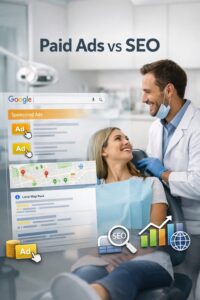
On a single Google search results page, a potential patient might see:
-
Google Ads at the top
-
Google Maps listings
-
Organic search results
-
Reviews and FAQs
-
Practice websites and landing pages
If your practice appears in only one of these areas, you’re competing at a disadvantage. If you appear in multiple, you dominate attention, trust, and clicks.
That’s where combining SEO and paid ads becomes powerful.
What SEO Does Best for Dental Practices
Search Engine Optimization (SEO) is the foundation of sustainable online visibility.
Long-Term Authority and Trust
SEO helps your practice:
-
Rank organically for high-intent keywords
-
Build credibility through content, reviews, and backlinks
-
Become a recognizable brand in your local market
When patients see your practice repeatedly in organic results, it signals legitimacy — even before they click.
Lower Cost Over Time
Unlike ads, SEO doesn’t charge you per click. Once rankings are established:
-
Traffic continues without daily ad spend
-
Cost per lead decreases over time
-
Marketing ROI compounds month after month
Capturing Research-Based Searches
SEO is especially strong for:
-
Educational searches (e.g., “Is Invisalign worth it?”)
-
Treatment comparisons
-
Blog and informational content
-
Long-tail, lower-competition keywords
These patients may not book immediately — but SEO plants the seed.
Where SEO Alone Falls Short
Despite its strengths, SEO has limitations — especially for growing practices.
SEO Takes Time
New or under-optimized websites can take:
-
3–6 months to gain traction
-
6–12 months to dominate competitive keywords
For practices needing patients now, SEO alone is often too slow.
Limited Control Over Search Placement
Even if you rank well:
-
Google can change algorithms
-
Competitors can outrank you
-
Ads can still push organic results down the page
SEO gives visibility — not guarantees.
What Paid Ads Do Best for Dental Practices
Paid advertising fills the gaps that SEO can’t.
Immediate Visibility for High-Intent Searches
Google Ads allow your practice to show up:
-
At the top of search results
-
For competitive keywords like “emergency dentist”
-
Exactly when someone is ready to book
This is critical for:
-
New practices
-
New service launches
-
High-value procedures (implants, Invisalign, veneers)
Precision Targeting
Paid ads allow you to control:
-
Location and radius
-
Time of day
-
Device type
-
Services promoted
-
Messaging and offers
You’re not waiting for Google to decide — you’re choosing who sees you.
Predictable Lead Flow
When managed correctly, paid ads provide:
-
Consistent appointment requests
-
Scalable patient acquisition
-
Clear data on cost per lead and ROI
This predictability is invaluable for planning growth.
Where Paid Ads Alone Fall Short
Just like SEO, paid ads aren’t perfect by themselves.
Ads Stop When Budget Stops
Turn off the ads, and:
-
Traffic disappears
-
Leads stop immediately
-
Growth stalls
There’s no compounding effect without organic visibility.
Rising Costs in Competitive Markets
Dental keywords are expensive. Without SEO support:
-
Cost per click rises
-
Cost per acquisition increases
-
ROI becomes harder to maintain
Paid ads work best when they’re not doing all the heavy lifting.
Why SEO and Paid Ads Work Better Together
The real magic happens when SEO and paid ads operate as one system.
Dominating the Search Results Page
When your practice appears:
-
In paid ads
-
In Google Maps
-
In organic listings
You occupy more screen space, build instant trust, and significantly increase click-through rates.
Patients think:
“They’re everywhere — they must be good.”
Data Sharing Between Channels
Paid ads provide real-time insights:
-
Which keywords convert
-
Which messaging works
-
Which services drive the most revenue
That data feeds directly into SEO strategy, allowing you to:
-
Optimize content around proven keywords
-
Create blogs and pages that actually convert
-
Focus SEO efforts where ROI is highest
Covering the Entire Patient Journey
Not all patients book immediately.
-
SEO nurtures early-stage research
-
Paid ads capture ready-to-book patients
-
Retargeting ads bring visitors back
-
Content builds trust before the call
Together, they move patients from clicks to chairs.
A Real-World Dental Marketing Example
Imagine two dental practices in the same city.
Practice A: SEO Only
-
Ranks well for informational keywords
-
Gets steady website traffic
-
Slower appointment growth
-
Misses high-intent emergency searches
Practice B: SEO + Paid Ads
-
Ranks organically for key services
-
Appears at the top with paid ads
-
Uses ads for emergency and high-value procedures
-
Retargets website visitors
-
Converts more traffic into bookings
Over time, Practice B:
-
Acquires patients faster
-
Lowers cost per acquisition
-
Builds a stronger brand presence
-
Scales predictably
Same market. Same city. Very different results.
How Dental Practices Should Allocate Budget
There’s no one-size-fits-all formula, but a balanced approach often looks like:
-
Early growth or new practices:
Higher ad spend + foundational SEO -
Established practices:
Strong SEO + strategic ads for competitive and high-value services -
Aggressive growth goals:
SEO for long-term dominance + ads for immediate scale
The key is alignment, not choosing sides.
Common Mistakes Dentists Make
-
Running ads without SEO support
Leads to high costs and short-term results. -
Doing SEO without conversion strategy
Traffic doesn’t equal booked appointments. -
Treating channels as separate silos
SEO and ads should inform each other. -
Not tracking real ROI
Clicks don’t matter — booked patients do.
The Goal Isn’t Traffic — It’s Patients
At the end of the day, dentists don’t want:
-
More clicks
-
More impressions
-
More website traffic
They want:
-
More phone calls
-
More appointment requests
-
More patients in chairs
That only happens when visibility, trust, and intent align — and that’s exactly what SEO and paid ads do together.
Final Thoughts: The Smart Way to Win Local Dental Search
Dental marketing isn’t about choosing SEO or paid ads.
It’s about building a system where:
-
SEO establishes authority and long-term growth
-
Paid ads deliver immediate, targeted patient acquisition
-
Both channels support and strengthen each other
Practices that understand this don’t just compete — they dominate their local market.
If your goal is to move patients from clicks to chairs, an integrated SEO and paid ads strategy isn’t optional anymore — it’s essential.
Recent Comments